Interactive Concept
Reimagining the Support Tier Model for AI
What changes when AI joins the tier model — and what stays exactly the same
Background
I designed the original three-tier support model for this organization — a structure built around human skill levels, escalation paths, and handoff protocols. It worked well for its time.
But support tier models were designed before AI existed as a practical workflow tool. The assumptions baked into the traditional model — that every ticket needs a human at first contact, that triage requires lived experience, that routing decisions happen after the fact — no longer hold.
The Question
If you were designing a three-tier support organization from scratch today, knowing what AI can reliably do and what it still can’t, how would the model change?
This concept explores that question interactively — letting you compare how the same ticket flows through a traditional model versus an AI-augmented one, and demonstrating a counterintuitive insight along the way.
The Key Insight
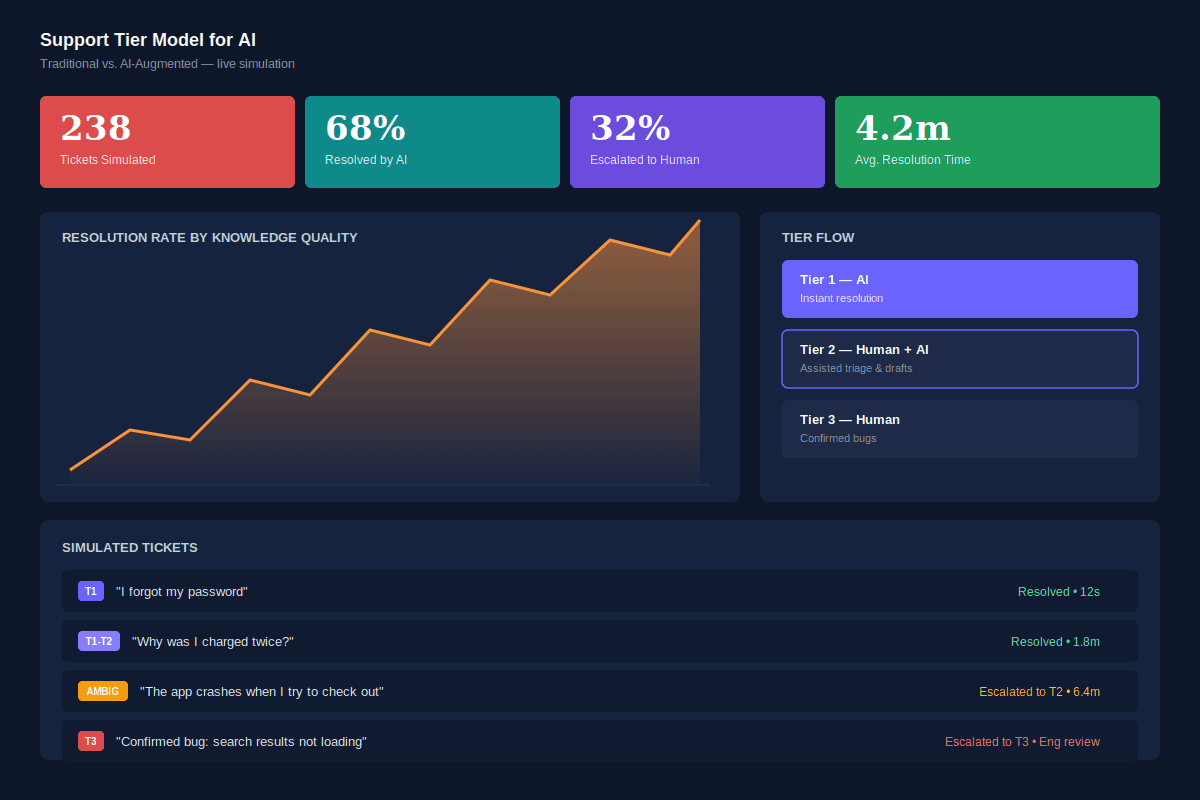
The AI model is not the differentiator. Two organizations using the same AI platform will get dramatically different outcomes — and the gap comes down to one thing: knowledge base quality.
High-quality documentation lets AI resolve tickets with confidence. Low-quality documentation produces deflection — tickets that didn’t reach a human, but weren’t actually resolved either. The simulator below makes this visible.
A second distinction worth making: deflection ratecounts any ticket that didn’t reach a human as a success. True resolution rate only counts tickets where the customer’s actual problem was fixed. Organizations optimizing for the wrong metric will over-invest in AI and under-invest in the documentation that makes AI work.
Framing
Throughout this model, freed agent capacity is described as redirected toward complex, judgment-driven work — not eliminated. AI-augmented support done well means humans spend less time on password resets and more time on the problems that require experience, empathy, and context.
Interactive Simulator
Select a ticket, choose a model, and simulate how it flows through the tiers. Adjust the knowledge base quality slider in AI-Augmented mode to see how much it moves the true resolution rate.
What I'd Build Differently
The redesigned model has three core changes from the original:
- AI as a pre-tier layer — not a replacement for any tier, but a structured first pass that classifies, enriches, and routes before a human ever touches the ticket
- Bypass routing for known defects — confirmed engineering issues skip T1 and T2 entirely, reducing time-to-engineering by hours
- Knowledge base as infrastructure — treated with the same rigor as tooling or headcount, with ownership, quality metrics, and a regular review cadence